TOTAL SOLAR ECLIPSE
2026
Wed, Aug 12
2026
Wed, Aug 12
A total solar eclipse will be visible on the European mainland for the first time in 27 years. Soon, the Moon will hide the Sun. The places where it can be seen and the ways to view it vary from person to person, but we all look up at the same sky. Whether you're there in person or watching live, let's enjoy this special moment together.
This time, a total solar eclipse, where the Sun is completely covered, will be visible in Greenland, Iceland, northern Spain, and parts of northeastern Portugal.
Iceland
maximum--
UTC
Partial eclipse begins
--:--
Total eclipse begins
--:--
Total eclipse ends
--:--
Partial eclipse ends
--:--
Weather on the day
View detailed weatherSpain
maximum--
UTC
Partial eclipse begins
--:--
Total eclipse begins
--:--
Total eclipse ends
--:--
Partial eclipse ends
--:--
Weather on the day
View detailed weatherNote: The values are estimates based on representative locations.
This time, a partial solar eclipse will be visible in most of Europe, parts of North America, and parts of Africa.
France
Eclipse magnitude --
UTC
Partial eclipse begins
--:--
Total eclipse begins
--:--
Total eclipse ends
--:--
Partial eclipse ends
--:--
Weather on the day
View detailed weatherUnited Kingdom
Eclipse magnitude --
UTC
Partial eclipse begins
--:--
Total eclipse begins
--:--
Total eclipse ends
--:--
Partial eclipse ends
--:--
Weather on the day
View detailed weatherNote: The values are estimates based on representative locations.
Head to Iceland or northern Spain if you can — or experience the eclipse LIVE with us from anywhere in the world.
A solar eclipse occurs when the Sun, Moon, and Earth align, and the Moon blocks the Sun's light. In areas where the umbra — the part of the Moon's shadow where light is completely blocked — falls, the Sun is entirely obscured, resulting in a total solar eclipse. In areas where the penumbra — the part of the Moon's shadow where light is only partially blocked — falls, only part of the Sun is obscured, resulting in a partial solar eclipse. Because the umbra is extremely narrow and small, total solar eclipses are visible only in very limited areas on Earth.
A lunar eclipse is the opposite: it occurs when the Earth comes between the Sun and the Moon, and the Earth's shadow falls on the Moon. Because the Earth's shadow is much larger than the Moon, lunar eclipses can be observed over a wide area and for a long duration — whereas solar eclipses, with their much smaller shadow, can only be seen for a short time and within a narrow area.
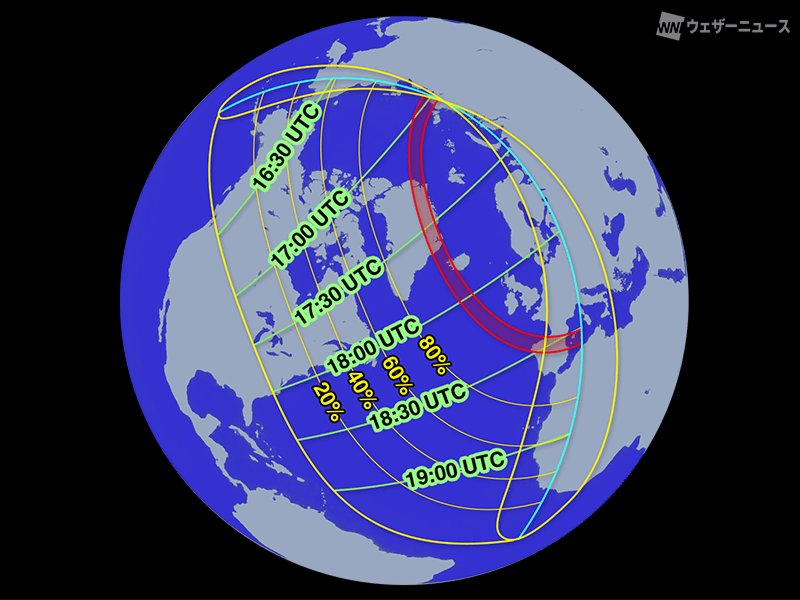
This indicates the areas where a solar eclipse will actually be visible.
The red belt shows the path of totality — the "total eclipse belt" for this event. In sync with the Earth's rotation, the path of totality moves and shifts its position over time.
The yellow line indicates the area where a partial solar eclipse can be observed. The closer you are to the path of totality, the larger the portion of the Sun that will be covered; the farther away, the smaller it will appear. The percentage marked on each line indicates the maximum percentage of the Sun's surface that the Moon will cover at that location.
The green line shows how the solar eclipse progresses over time. The time (UTC) marked on each line indicates when the maximum eclipse occurs along that line.
This time, a total solar eclipse will be visible in Iceland and northern Spain, which lie in the path of totality, while a partial solar eclipse will be visible across most of the rest of Europe, parts of North America, and parts of Africa.
This is an extremely rare phenomenon in which a total solar eclipse coincides with the sun setting. Near the horizon, you can witness the partially eclipsed sun — or the completely darkened sun during totality — sinking below the horizon, creating a breathtaking and otherworldly scene unlike any ordinary solar eclipse.
This time, northern Spain falls into a remarkable pattern known as a "sunset total solar eclipse" — a total solar eclipse that coincides precisely with sunset. This is an extremely rare event worldwide, and it marks the first time a total solar eclipse has been visible from mainland Europe in 27 years, since 1999.
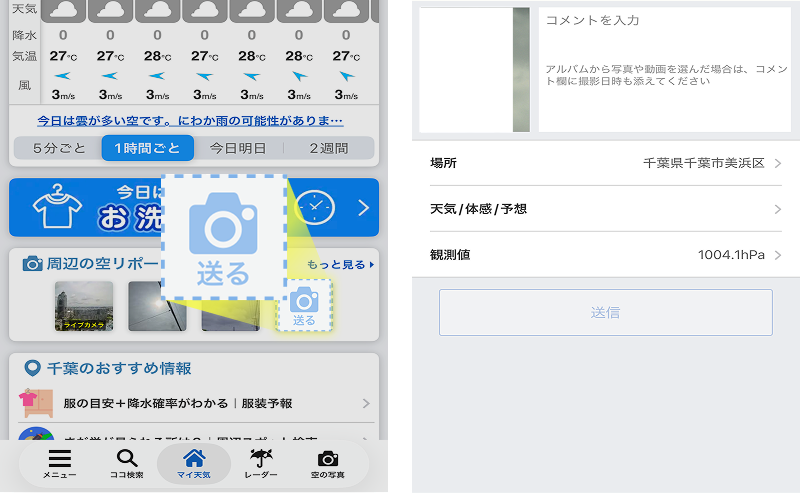
Open My Weather (home screen)
Tap the camera tab at the bottom right of the screen, then tap the green camera icon above it.
Select photos or videos of the solar eclipse from your album (you can also take new ones)
Freely share what you saw or your impressions. If you selected photos or videos from your album, please also include the date and time they were taken in the comment field.
Confirm the location you are reporting from (e.g., Mihama Ward, Chiba City, Chiba Prefecture). If incorrect, select a different location.
In the "Weather/Feels-like/Forecast" section, select the sky conditions as you see them, and enter observational data such as atmospheric pressure if needed.
After confirming the content, tap the submit button to post the report.
To enjoy a solar eclipse safely, it is essential to use specialized observation equipment.
Glasses fitted with a specialized filter designed for solar observation. They allow you to observe the Sun more safely than with the naked eye.
Using binoculars or telescopes fitted with solar observation filters allows you to observe changes in the Sun's shape in greater detail.